
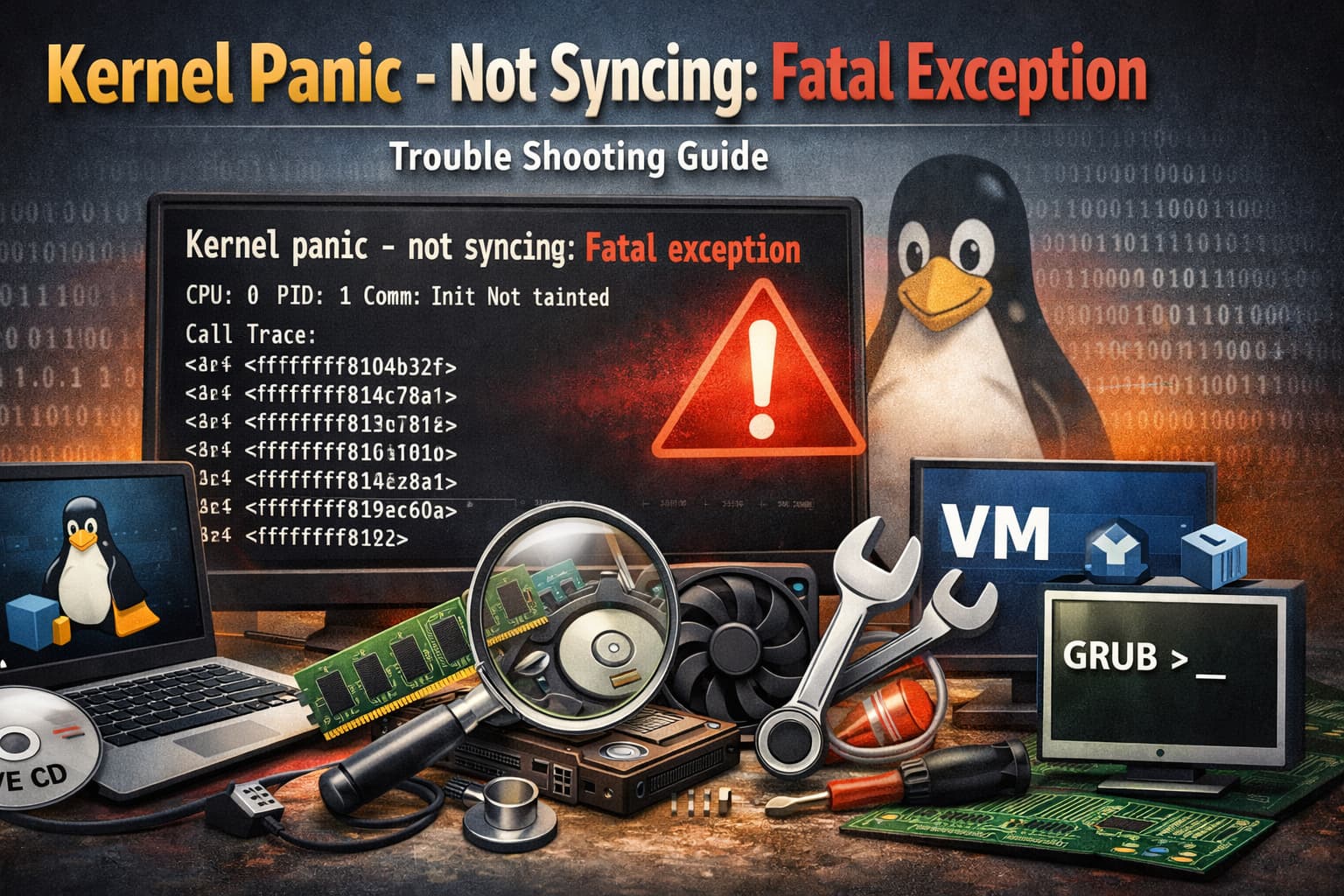
No need to freak out when you see a black screen with white text including the “Kernel panic – not syncing: Fatal exception” message. This bug causes your Linux box to hang, or to fail to boot and mount a drive. It’s frustrating for her, but it is often fixable. In this article, we will explain what this error is; Why it happens and How to fix PS4 CE-30022-7.
This error indicates a critical, unrecoverable problem at the core of the operating system — essentially the kernel. The kernel, when confronted with something it doesn’t understand, crashes qemu to avoid corruption. Cause is the first step to a cure.”
What is a Kernel Panic and Why Does It Happen?
A kernel panic is a response in Linux and other Unix-like operating systems. When system identifies any internal fatal error from which it cannot be recovered without risk, then in such circumstances all the processing of system shall cease. If it’s not doing anything, it means that the kernel could not sync cache with the disk – which is why it stops everything to ensure there is no data inconsistency.
The “Fatal exception” refers to the type of error that has been encountered. It’s a generic message that indicates a serious problem, either with hardware or essential software components.
Common causes include:
Data Corruption: A software installation or update may have corrupted the kernel or its modules.
Faulty Hardware: A loose RAM chip, or a hard drive that’s starting to go bad can cause kernel panics. Published 09/9/12 DID YOU KNOW?ált;/ Is there a product or service Product Description Consider various supported operating systems :BIOS Guardian relates to the trend in some brand name PCs for an increasing number of fences known as “gates” (e..
Driver Issues: A driver that’s incompatible with your system is a common cause, and this is more likely to occur if you’ve assembled your own PC.
Issues in Initial RAM Disk (initramfs): If something goes wrong with the initramfs – a temporary root file system used during booting -for example, because it’s corrupted or misconfigured, your kernel won’t be able to locate the drivers it needs to mount the real root filesystem.
Wrong Boot Parameters: The wrong boot parameters can cause GRUB to not load the kernel properly.
Fix Kernel Panic – Not Syncing: Fatal Exception in the Linux…
We need to pin point the cause of this error. Since you’re probably not able to boot your system, you need to access the GRUB menu or a live USB/CD.
Step 1: Boot and Try with an Old Kernel

On distribution with Linux, such as Ubuntu/Debian or Arch/similar distributions leave older kernel versions in the boot menu. This is usually the fastest way to fix things, especially if you just saw that the kernel panic after update screen.
Reboot your computer.
When you see a GRUB boot loader menu, select “Advanced options“ for your distribution (‘’e.g., for Ubuntu [ advanced options] *”Advanced options for Ubuntu”)”.
You will be presented with a list of kernel versions. Select one of the older ones (not the top-most) – press Enter.
If the system successfully boots, there is an issue with the latest kernel or associated driver.
After you login, either wait for the next kernel update that will hopefully fix the issue or uninstall the offending Kernel. Follow these instructions to remove a bad kernel in Debian or Ubuntu: Find the version of your current kernel To learn whether a particular Linux kernel package is installed, run this command: dpkg -l | grep image-suffic where suffic is the suffix attached to linux-image.
Determine the package name of the broken kernel
dpkg –list | grep linux-image
Uninstall the defect kernel (note: this is the version number to change) dpkg-rm package_v1 # where 1 is your desired solution number.
sudo apt-get purge linux-image-x. x.x-x-generic
sudo update-grub
Step 2: Inspect Your System’s Hardware

If booting the older kernel does not solve the problem, it’s likely a hardware issue.
Inspect RAM: Bad memory is a leading culprit. use something like MemTest86+ to do a proper test. It can be run from a bootable USB drive. Let it run a few hours or passes to make sure your RAM is stable.
Verify Hard Drive/SSD: A malfunctioning hard drive or SSD may corrupt files, leading to a kernel panic. Then boot from a live USB. Afterward, use disk utility tools, in the same location, to test your drive. For example, with the smartctl command.

Check for Overheating: Make sure your CPU and other hardware are not overheating. Clean all fans and heat sinks of dust, make sure airflow is good.
Step 3: Repairing Your File System From A Live Environment

If you think your file system is corrupted, booting into a live Linux environment and running checks can help.
Create bootable USB of your Linux Graphically (e.g., Ubuntu, Debian) here- Now this is a workporcess.
Boot your computer, select the USB drive and choose “Try” (e.g., “Try Ubuntu without installing”).
You have the live desktop, launch a terminal.
Find the device name of your root partition with lsblk, or fdisk -l.
Run a fsck on your root partition. /dev/sdXY should be replaced with the partition that you want to fix. sudo fsck /dev/sdXY -y
Try rebooting your system after the check is finished to test if it helped.
Step 4: Recreating the Initial RAM Disk (initramfs) if Necessary
initramfs can be corrupt and lead to a fatal exception kernel panic after boot. You’ll have to chroot in your current installation from live environment.
Boot from a live USB.
Open a terminal and then mount the root partition of your system. # Replace /dev/sdXY with the drive/partition that you installed Gara to.
sudo mount /dev/sdXY /mnt
Mount other necessary system directories
sudo mount –bind /dev /mnt/dev
sudo mount –bind /proc /mnt/proc
sudo mount –bind /sys /mnt/sys
chroot into your mounted system. sudo chroot /mnt
Now, rebuild the initramfs. # The command will update all installed kernels.
update-initramfs -u -k all
Update GRUB for good measure. update-grub
Leave the chroot and unmount the partitions and reboot. exit
sudo umount -R /mnt
sudo reboot
Step 5: Fix the Kernel Panic on a Virtual Machine

If you face a kernel panic fatal exception virtualbox, vmware or kvm it’s often that the setup of your virtual machine is to blame.
Ram: Vm may have less memory assigned. You could try and bump up the base memory in the VM’s settings.
Try a Different Graphics Controller: In VirtualBox, go to Setting > Display and try switching the Graphics Controller between VBoxVGA and VMSVGA or between VBoxSVGA – same one I used there from the first tip.
Enable/Disable 3D Acceleration: Switching on or off the 3D acceleration may help to resolve driver issues in the guest OS.
Reinstall Guest Additions/VMware Tools If your VM or system boots with an old kernel, try reinstalling the related virtualization tools (Guest Additions for VirtualBox, VMware tools).
Common Mistakes and Prevention

To ensure that this doesn’t happen in the future, practice the following.
Do Not Power Off: Always shutdown your system properly. A bad power-off can trash files on disk.
Backup First Before updating the system, at least backup your important data! Apps such as Timeshift can make backups of the system, so you have a less perilous fall back if the upgrade were to fail.
Stick to stable software sources: If you are not an advanced user who requires the latest software, use only stable and officially supported software repositories for your distribution.
Keep an eye on your hardware: Check the S.M.A.R.T. status of your drives and temperatures inside the PC, as well as run a basic software suite that warns you of impending hardware failure like Storage Executive so you can catch issues before they become catastrophic failures.
Frequently Asked Questions
Can my hardware be harmed by a kernel panic?
Kernel panic does not damage hardware. It’s a software solution to what sounds like it may be questionable hardware. The panic is intended to prevent additional harm, most of all to your data.
How can I stop a fatal kernel panic between Ubuntu 10.23 and 13.04?
The most frequent solution for a kernel panic fatal exception ubuntu is to boot from an older kernel, available from the GRUB menu (again, “Advanced options”). If that did the trick, you can purge the offending kernel and wait for a reissue. If not, it is time to try swapping out hardware (RAM and disks) or repairing the file system from a live USB.
What would cause a kernel panic after an update?
A kernel panic (fatal exception) following an update in general is the new kernel having a bug or being incompatible with a hardware driver on your machine. It may also occur if update is interrupted and files become corrupt.
Is the Linux install gone with this mistake?
Not necessarily. Generally, the data and the installation are recoverable. The mistake you make doesn’t let the system boot up, though it doesn’t delete your files. By resolving the factory image with the following methods, you are often able to bring your system back to a working configuration.
Conclusion
Fixing/ dealing withKernel panic – not syncing: Fatal exception is not a easy task,We have to troubleshoot it in step by step manner. It’s really bad, but it doesn’t have to be a death sentence for your system. Begin with the easiest fix of them all—booting to an older kernel—and gradually work through more complex solutions such as testing hardware and repairing system files from a live CD.
By learning what could possibly go wrong and how to diagnose the problem, you can increase your chances of being able to resolve this issue without too much downtime. Just remember to backup regularly, and you’ll never lose important data even if something goes horribly wrong.

Leave a Comment